7–8 min read
Can AI Help During Busy Seasons? How Home Service Businesses Can Stay Ahead
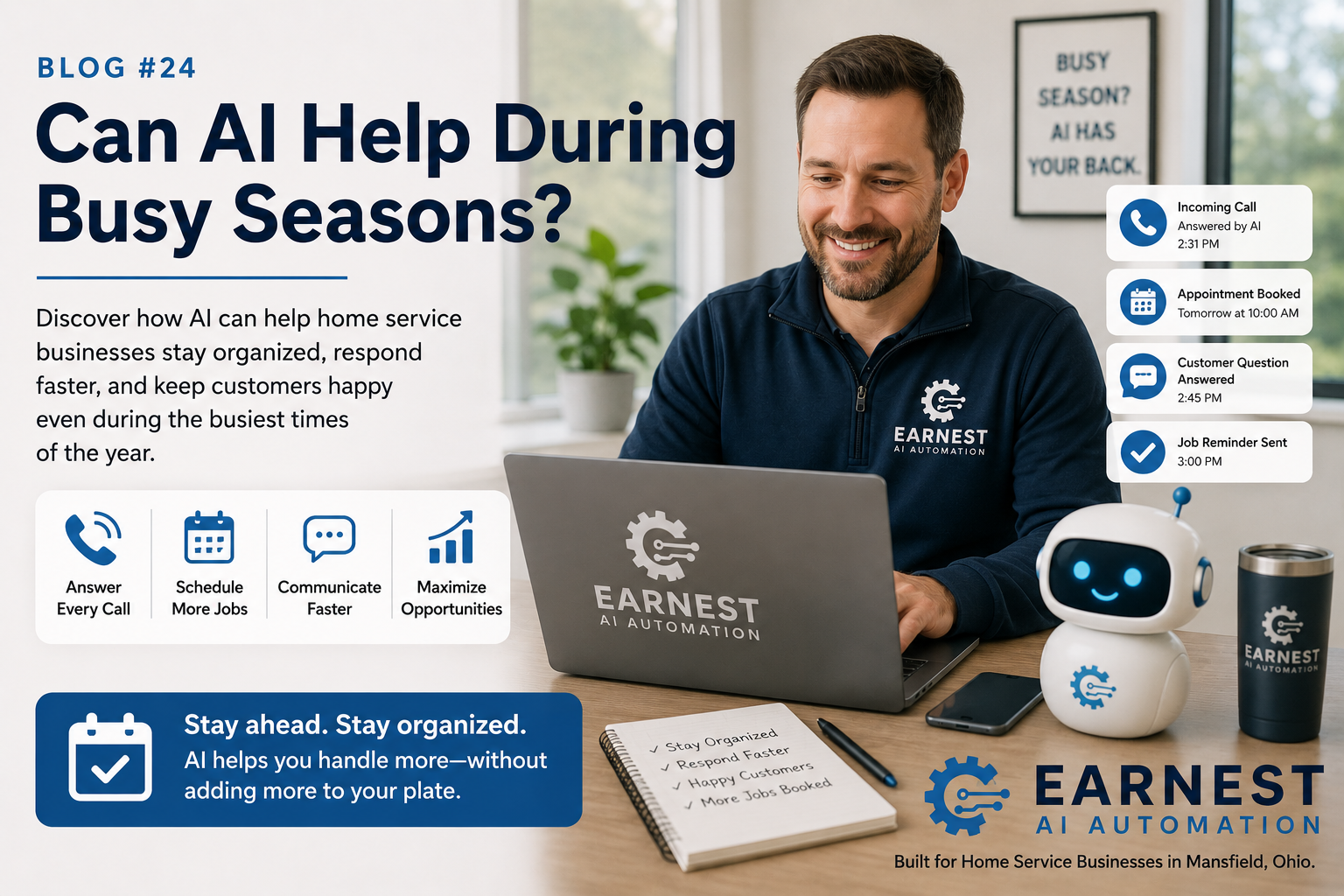
Busy seasons can be great for a home service business.
They can also expose every weakness in the way the business handles calls, scheduling, follow-up, and customer communication.
The phone rings more often. The schedule fills up faster. Customers need answers. Technicians need information. New leads need follow-up. And the same team that normally handles all of that suddenly has far more work coming at them.
That's where AI can become useful.
Not because your business suddenly needs to replace its people. And not because AI should take over everything during the busiest time of the year.
The opportunity is much simpler:
AI can help handle some of the repetitive communication and administrative work that becomes harder to keep up with when demand increases.
Why Busy Seasons Create So Much Pressure
Every home service business has periods when demand increases.
For one business, it might be summer. For another, it might be the first cold snap of the year. A roofing company may experience a surge after a major storm. An HVAC company may get flooded with calls when temperatures change dramatically. A plumber may see more emergency calls during certain weather conditions.
The specific season doesn't matter as much as what happens operationally. More customers are trying to reach you at the same time. That creates pressure throughout the business.
Your office team may have to answer more calls. Your technicians may need more coordination. Your scheduling process may become more complicated. And follow-up that was manageable during a normal week can suddenly become difficult to maintain.
The problem isn't necessarily that your team isn't working hard enough. The problem is that volume changes the workload.
AI Can Help Answer More Calls
One of the first pressure points during a busy season is usually the phone.
Your office manager or receptionist may be doing everything possible to keep up. But a person can only handle one conversation at a time. When several customers call simultaneously, some calls may go unanswered or be sent to voicemail.
An AI receptionist can provide another layer of coverage. Depending on how it is configured, AI can answer incoming calls, collect information, answer approved questions, help with scheduling, and determine whether the caller needs to be transferred to someone on your team.
That doesn't mean every call should be handled entirely by AI. Some conversations will still require a person. The benefit is that routine calls and overflow don't necessarily have to compete for the same human attention. That can be especially useful when your team is already stretched thin.
AI Can Help With Scheduling Pressure
Busy seasons don't just create more calls. They create more scheduling activity.
Customers want appointments. Technicians have limited availability. Jobs take different amounts of time. Appointments move. Emergencies appear. A schedule that is relatively simple during a normal week can become much harder to manage when demand increases.
AI can help with portions of that workflow. For example, it may be able to help customers request appointments, collect information needed for scheduling, send confirmations, or handle routine scheduling communication.
The exact capabilities depend on the system and the way your business operates. The goal isn't to remove the scheduler or office manager. It's to reduce the number of routine scheduling interactions that require someone to personally handle every step.
AI Can Help Keep Customers Informed
During a busy season, customers may be more willing to wait for service. They are also more likely to have questions.
- "When can someone come out?"
- "Did you receive my request?"
- "Is my appointment confirmed?"
- "Can I change my appointment?"
- "Has the technician been dispatched?"
Some of these questions are straightforward. But answering them still takes time. AI can help handle appropriate routine questions and communications according to the information and rules your business provides.
Communication becomes even more valuable when customers are waiting.
Even when you can't get someone to the property immediately, keeping the customer informed can make the experience much better.
AI Can Help With Follow-Up When Volume Increases
Follow-up is often one of the first things to slip when a business gets busy.
A lead comes in. Someone intends to call back. Then another call arrives. A technician needs help. A customer has a scheduling problem. The office gets busy. That original lead is suddenly buried.
AI can help create consistent follow-up workflows so routine steps don't depend entirely on someone remembering to perform them manually. That might include following up with a new inquiry, confirming an appointment, sending a reminder, or communicating another routine next step.
The office team can still oversee the process. The difference is that the system helps keep repetitive follow-up moving while people handle the exceptions.
AI Can Help Your Team Stay Organized
Busy seasons don't just create more work. They create more interruptions.
Your office manager may be trying to solve one problem when another person asks for information. A customer calls while someone else is already on the phone. A technician needs an update. A new lead needs attention. A customer wants to reschedule.
The constant switching can make an already demanding day even harder. AI can help absorb some of the predictable requests and routine workflows. That can give your team more room to concentrate on the work that requires judgment.
Think of it as a buffer. AI handles some of the repetition so your people can handle the complexity.
AI Can Help Without Replacing Your Team
This is an important distinction. Busy seasons are exactly when experienced employees can be most valuable.
Your office manager knows how your business works. Your technicians know how to solve problems in the field. Your customer-service team understands your customers. Those people shouldn't disappear from the process.
Instead, AI can support them. An AI receptionist can handle certain calls. An automated workflow can send reminders. A system can help with routine follow-up. Customers can receive basic information without waiting for someone to become available.
The goal isn't fewer people. The goal is giving your existing people better support when the workload increases.
What Happens When a Customer Needs a Human?
This is where a good AI workflow needs clear boundaries. Not every situation should be automated.
A customer with a complicated problem may need a person. An upset customer may need empathy. A scheduling exception may require judgment. A technician may need help resolving something unusual.
AI should be configured to recognize when a conversation or task needs to move to the human team. That might mean transferring a call, creating a task, sending an alert, or otherwise escalating the situation.
Automate the predictable. Escalate the important.
What If the Busy Season Is Unexpected?
Not every surge is predictable. A major storm can create a sudden wave of calls. An equipment failure can create unexpected demand. A weather event can dramatically change the number of people looking for service.
You may not have time to hire and train additional office staff before the phones start ringing. This is another area where an established AI workflow can provide useful support. If the system is already configured, it can help absorb additional communication without requiring you to build an entirely new process in the middle of the rush.
That doesn't eliminate the need for your team. It simply gives them another tool to work with.
The Best Time to Prepare Is Before You Need It
One of the biggest mistakes a business can make is waiting until the busiest week of the year to figure out how automation should work.
Automation works best when the workflow has already been thought through. Before your busy season arrives, you can identify:
- Which calls are routine
- Which questions customers ask most often
- Which information AI should collect
- Which appointments can be handled automatically
- Which messages should be sent
- Which situations should be transferred to a person
- Which workflows require human approval
That gives you time to test the process. You can make adjustments. Your team can become familiar with how the system works. And when demand increases, you're not trying to build the system while the phones are already ringing.
Start With the Biggest Bottleneck
You don't have to automate your entire business before the next busy season. In fact, that may be the wrong approach.
Start by identifying the area that creates the most pressure.
Is it missed calls? Is it appointment scheduling? Is it follow-up? Is it customer communication? Is it repetitive administrative work?
Once you know where the bottleneck is, you can determine whether automation is a good fit. You can also see how AI fits alongside the other systems your business already uses.
For example, you may want to explore AI appointment scheduling or learn more about how AI can support an office manager.
Busy Seasons Don't Have to Mean Chaotic Seasons
A busy season is still going to be busy. AI isn't going to change that. You will still have more customers. Your technicians will still have more work. Your schedule will still be full.
But the way your business handles that increased volume can be different. If routine calls are answered, customers receive timely communication, follow-up continues, and your team isn't personally responsible for every repetitive task, the business may be better positioned to handle the increase.
That's the practical value of automation. Not making your business run itself. Not replacing your employees.
Making it easier for your existing team to keep up when demand gets high.
AI Can Help You Handle the Rush
So, can AI help during busy seasons?
Yes.
It can help provide additional call coverage, support scheduling workflows, maintain follow-up, answer appropriate customer questions, and reduce some of the repetitive administrative work that becomes harder to manage when demand increases.
But the best results come from using AI as part of a thoughtful workflow. Your people remain responsible for the situations that require judgment, empathy, and experience. AI handles the predictable work around them.
If you prepare that system before the next rush arrives, your team can enter the busy season with more support instead of simply more pressure.
The goal isn't to make busy seasons less busy. It's to make your business better equipped to handle them.
Want to see where AI could help your business handle higher demand?
An Earnest AI Automation Business Systems Assessment can help identify repetitive calls, scheduling, follow-up, and administrative workflows that may be good candidates for automation.
